
Anti-dumping issues are one of the most misunderstood risks in international trade.
When a shipment is inspected, delayed, or hit with unexpected duties, the first reaction is often:
“Who is responsible for this?”
The buyer blames the seller.
The seller blames customs.
And the freight forwarder is often caught in the middle.
In reality, anti-dumping risk is not accidental — it is structural, and responsibility depends on who controls which decision.
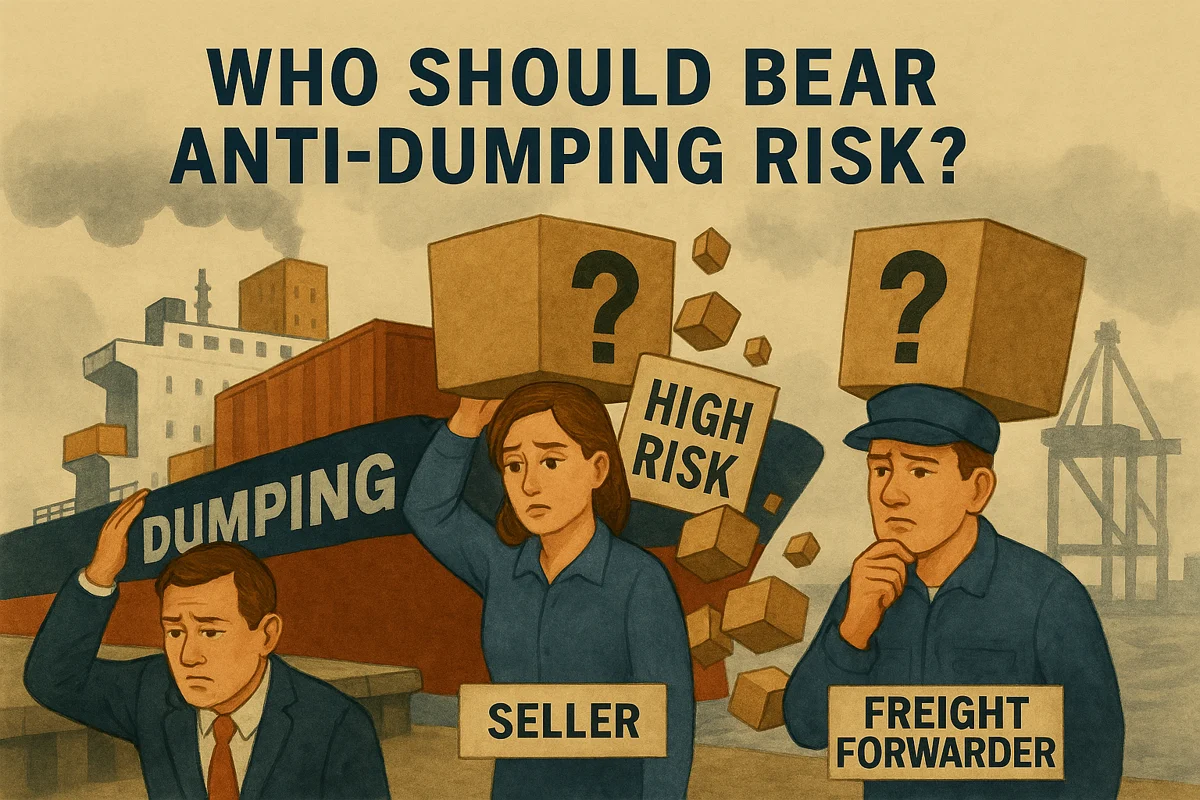
Let’s break it down clearly.
- The Buyer: The Ultimate Risk Holder
From a legal and practical perspective, the importer of record bears the final responsibility.
Why?
Because the buyer:
- Chooses the product category
- Accepts the HS code used for import
- Declares the customs value
- Pays duties, penalties, and storage fees
- Faces compliance consequences
Even if the seller provides incorrect information, customs will still pursue the importer of record.
Key truth:
Anti-dumping duties are imposed on imports — not exports.
That means the buyer cannot fully outsource this risk.
What buyers should realistically own
- Understanding whether the product is AD/CVD-sensitive
- Knowing the historical enforcement environment
- Deciding whether the price justifies the risk
- Preparing financially for inspections or reassessments
Ignoring risk does not transfer it — it simply postpones the cost.
- The Seller: Responsible for Accuracy, Not Immunity
Sellers often believe:
“Once the goods leave the factory, it’s no longer my problem.”
That assumption is dangerous.
While sellers do not pay U.S. duties directly, they contribute materially to risk creation through:
- Product classification suggestions
- Declared values and invoices
- Country-of-origin statements
- Production and material disclosures
Where sellers are responsible
- Providing accurate product descriptions
- Declaring truthful values
- Disclosing prior AD exposure
- Avoiding intentional misclassification
Where sellers are not responsible
- Final customs decisions
- Duty rate changes
- Random or targeted inspections
However, when a seller:
- Encourages HS code manipulation
- Pushes unrealistically low values
- Claims “guaranteed clearance”
They are effectively shifting commercial risk onto the buyer, often without saying so explicitly.
- The Freight Forwarder: Risk Identifier, Not Risk Owner
This is where confusion is most common.
A professional freight forwarder:
- Does not control HS codes
- Does not set declared values
- Does not decide duty policy
What a competent freight forwarder should do is:
- Flag anti-dumping exposure before booking
- Explain inspection likelihood
- Estimate time and cost impact if inspected
- Advise on routing and cargo structuring risks
What freight forwarders cannot do
- “Clear” anti-dumping products by skill alone
- Override customs enforcement
- Absorb duties or penalties on behalf of the importer
When a forwarder promises:
“No problem, we can handle it.”
Without clarifying risk ownership, that is not expertise — that is misrepresentation.
- The Real Question Is Not “Who Pays,” But “Who Decides”
Anti-dumping risk follows decision-making power, not job titles.
| Decision | Primary Controller |
| Product selection | Buyer |
| Manufacturing details | Seller |
| Pricing | Buyer & Seller |
| HS code declaration | Importer (Buyer) |
| Risk disclosure | Forwarder |
| Duty payment | Buyer |
Problems arise when:
- Decisions are made by one party
- Risks are silently absorbed by another
That misalignment is where disputes begin.
- How Smart Importers Handle Anti-Dumping Risk
Experienced importers do not ask:
“Can this ship?”
They ask:
“If this is inspected, what happens — and who absorbs the cost?”
Best practices include:
- Written risk disclosure before booking
- Clear Incoterms and liability clauses
- AD/CVD checks during product sourcing
- Budgeting inspection delays into timelines
- Choosing forwarders who warn, not reassure blindly
Final Takeaway
Anti-dumping risk is not a clearance issue.
It is a commercial risk allocation issue.
- Buyers cannot outsource responsibility
- Sellers must not create hidden exposure
- Freight forwarders must surface risk early — not sell false certainty
The only real mistake is discovering all this after the container arrives.
If risk is discussed early, it can be managed.
If it is ignored, it will be enforced.